

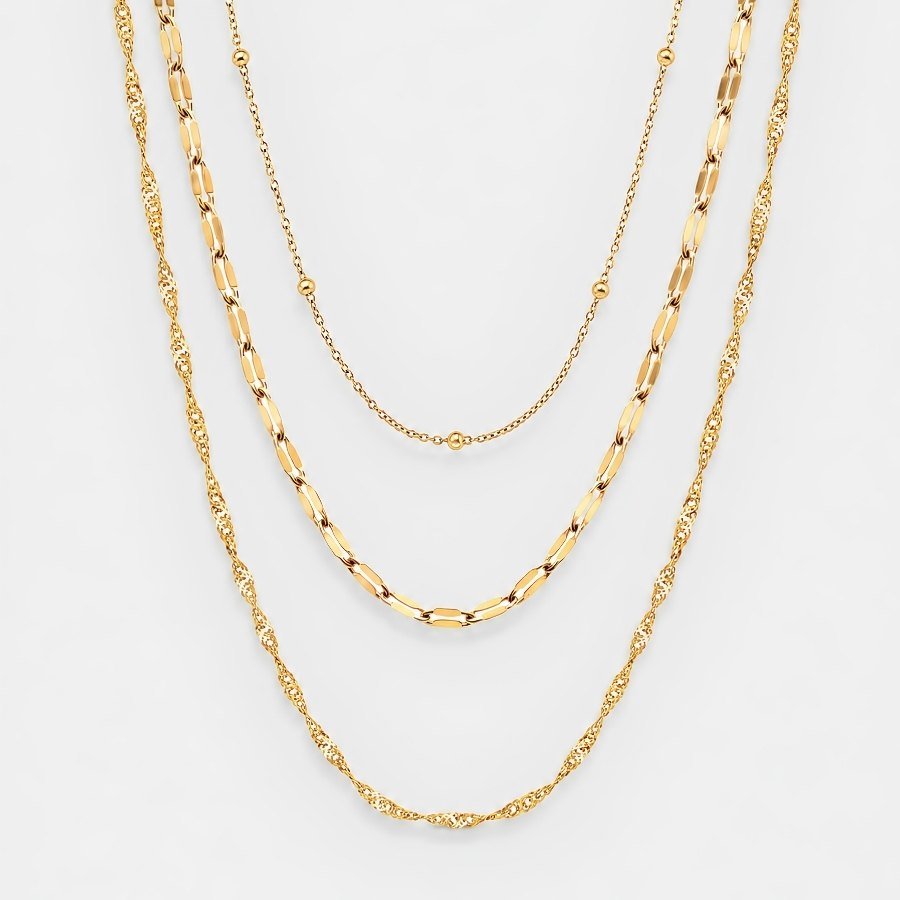
Gold Filled vs Gold Plated: The Quick, Honest Answer

Gold Filled vs Plated
The Quick, Honest Answer
The materials question, answered cleanly: sheet against deposit, the numbers behind each, and the bonded third option the comparison usually forgets.
Cutting to the third option? The bonded-gold collection runs it from £24.
The Answer in One Section
Gold filled bonds a thick sheet of real karat gold, legally 5%+ of the item's weight, over a core; gold plated deposits a microscopically thin layer by electroplating. Same family, different orders of magnitude, and the wear gap follows directly.
The one-section verdict: gold filled outlasts standard plating by roughly ten times in daily wear (years against months, per the numbers below and the layered-gold files), costs accordingly more, and carries US-standard marks where plating's vocabulary runs vaguer. For any piece meant to last, filled beats plated wherever both are offered, and the only questions left are the numbers, the marks, and the third option the debate forgets, each below.
The Numbers Behind It
The gap, quantified per the series' standing files.
Thickness: standard electroplate runs around a micron; gold filled's sheet runs to hundreds of equivalent microns by weight-share, the 5% floor making the gap structural rather than incremental. Lifespan: plating's 6-to-24 daily-wear months against filled's 5-to-15 cared years, friction erasing deposits while merely wearing sheets. Failure modes: plating breaches to reactive brass early (the green-marks chemistry); filled's breaches arrive at decade-edge-wear scale. Price: plating's pennies-of-gold against filled's weighed sheet, the retail gap (roughly 2-to-4×) honestly tracking the material one. The numbers' sum: the constructions share a family tree and almost nothing else the wearer experiences.
Reading the Marks
The label literacy, compressed to its final form.
Filled's marks: "GF" with fraction and karat ("1/20 14k GF"), the regulated signature, fraction and karat both present or the claim stays unverified. Plating's vocabulary: "gold plated" (assume ~1 micron on brass unless stated), "gold tone" (the theatre tier announcing itself), "18k gold plated" (the karat describing colour, never durability, per the standing myth files), and vermeil's named exception (thick plating on sterling, its own dossier). The literacy's final statement: the materials line is the product, the adjectives are the wrapping, and every guide in this series was teaching this one paragraph.
The Third Option
The comparison's standard framing forgets the bonded column, and the forgetting costs buyers.
The third option: 18k PVD bonded to 316L steel, per the decade files, matching filled's long-life years while dropping its calendar entirely, showers, seas and chlorine ignored, at prices below filled's US-import tier. The three-way honest map: plated for theatre's honest occasions, filled for the real-gold-surface purists running a light calendar, bonded for the never-think-about-it life, and solid above all three where forever's budget exists. The forgetting's cause is historical (the filled-versus-plated debate predating the bonded column's rise), and its cure is this section: the modern comparison runs three ways, and the third answer wins the daily brief the other two were fighting over.
The Routing
The routing that closes the guide's materials arc.
The briefs, routed: the trend experiment to honest plating at theatre prices; the US-aesthetic and permanent-chain briefs to marked gold-filled via the maker-tier literacy; the daily-wear heartland, the registers, the anchors, the never-off pieces, to the bonded column's carefree physics; and the milestone-forever briefs to solid's ceiling. The arc's closing note: this guide caps the materials map this series has been drawing, construction by construction, and the map's whole purpose is achieved if one habit survives it, the materials line read first, always, everywhere.
The Mistakes
The Four Buying Mistakes
The comparison's real-world failures are four repeatable mistakes, each with a one-line cure.
Mistake one, paying filled prices for plated goods: listings that say "gold filled" with no GF fraction-mark are, statistically, plated; the cure is refusing the claim without the mark. Mistake two, reading karat as durability: "18k gold plated" outranks "14k gold filled" only in colour warmth, never in survival; the cure is remembering karat describes the layer, thickness describes the life. Mistake three, buying plated for the never-off brief: the shower chain, the sleep-in huggies, the gym ring, plating's months cannot serve them at any karat; the cure is routing that brief to filled or bonded before checkout. Mistake four, forgetting the third option entirely: paying maker-tier import prices for filled when the actual brief was carefree daily wear the bonded column serves for less; the cure is section four of this guide.
The pattern under all four: every mistake is a vocabulary failure before it is a purchase failure. The listing said something true-sounding, the buyer heard something else, and the gap cost real money. The marks grammar and the three-way map close that gap permanently.
The Maths
The Cost-Per-Year Maths
Price tags mislead in this comparison; cost per wearing year is the honest currency.
The worked example, using the series' standing lifespans: a £25 plated chain worn daily survives its honest 6-to-24 months, call it a year, £25 per wearing year. A £70 gold-filled equivalent runs its cared-for 5-to-15 years, call it eight, roughly £9 per year plus the light calendar's attention. A £29 bonded PVD chain runs its carefree 5-to-10, call it seven, about £4 per year with no calendar at all. The ranking inverts the price tags entirely, which is the point: plated is the most expensive way to wear gold colour daily, filled is cheap per year but paid upfront and in attention, and the bonded column undercuts both while asking nothing.
Where plated genuinely wins the maths: the trend experiment. A shape you are auditioning for one season costs least at the theatre tier, and graduating the shapes that earn permanence up to filled or bonded is the whole system working as designed.
The Wardrobe
The Three-Construction Wardrobe
The comparison's endgame is a wardrobe that uses all three tiers on purpose.
The build: a bonded daily core, chain, huggies, ring, the never-off infrastructure running the carefree decade; a filled or solid register tier for the pieces whose real-gold surface matters to you, worn on the light calendar and the marks-checked supply; and a plated experiment shelf, refreshed seasonally at theatre prices, auditioning shapes for promotion. The flows between tiers are the system's engine: shapes that earn daily status graduate from plated to bonded, pieces that earn sentiment graduate toward filled and solid, and nothing expensive is ever bought untested. Priced out, the whole three-tier wardrobe builds for less than one mid-range solid piece, which is the quiet arithmetic this entire comparison, and the season of guides behind it, was written to hand you.
The Key Takeaways
The final answer in five lines.
- Sheet against deposit: filled's 5%-weight bonded gold against plating's micron, structurally different products.
- Ten times the life: cared years against careful months, the gap the thickness writes.
- Marks tell the truth: "1/20 14k GF" regulated, plating's adjectives read per the literacy.
- The third option wins the daily: bonded PVD matching filled's years without its calendar.
- The one habit: the materials line first, always, everywhere.
Frequently Asked Questions
What is the difference between gold filled and gold plated?
Construction scale: filled bonds real gold sheet at 5%+ of item weight; plated deposits a ~1-micron layer, the wear gap (years versus months) following directly.
Is gold filled worth the extra cost?
For lasting pieces, decisively: the 2-to-4× price buys roughly 10× the daily-wear life, per the standing lifespan files.
Does gold filled tarnish or fade?
Far slower than plating: the sheet wears at decade-edge scale, with the real-gold surface running gold's own chemistry meanwhile.
Can you shower with gold filled?
Reasonably, chlorine moderated, better than any plating, short of bonded steel's total indifference, per the cared-middle's contract.
What does GF mean on jewellery?
Gold filled's regulated mark, with fraction and karat ("1/20 14k GF") stating the gold sheet's weight share, absence meaning unverified.
Is 18k gold plated better than gold filled?
No, the karat describes the layer's colour, not its survival: filled's 14k sheet outlasts any karat of micron-scale plating by multiples.
What is better than both?
By brief: bonded PVD-on-steel for carefree daily years at lower prices, and solid gold for forever at forever's budget, the three-way map's other answers.
Why is gold filled hard to find in the UK?
The standard is American: UK supply runs maker-tier imports and permanent-jewellery stock, per the market-reality files, marks read before trust.
Which is better for sensitive skin?
Filled's gold surface serves well; plating serves until breach; and bonded steel's hypoallergenic files lead the category, per the skin dossiers.
Gold filled or vermeil?
Filled outlasts vermeil's microns on durability; vermeil counters with sterling's base and UK availability, both running the layered calendar.
What should daily-wear jewellery actually be?
The routing's heartland answer: bonded 18k-PVD on 316L, filled's longevity without its calendar, from £24 at the standing tier.
What is the one habit this comparison teaches?
The series' whole literacy: read the materials line first, the adjectives never, and route every purchase by its honest construction.
The Materials Line, First
Bonded 18k gold on 316L steel: the daily answer to the whole comparison, from £24, no calendar attached.
Shop the Third OptionThe map's full files: vermeil vs plated and the plating guide.